
Common Cryptocurrency Tax Mistakes and How to Avoid Them
Learn from others' errors—a practical guide to keeping your crypto taxes accurate and stress-free.
CRYPTO TAX GUIDE

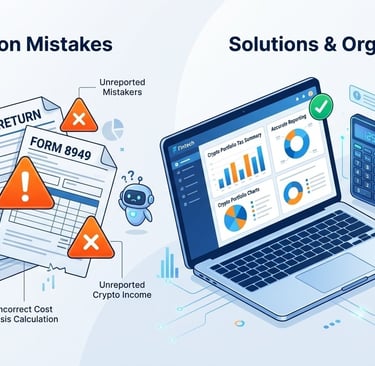
Introduction
As cryptocurrency has moved from the fringes to the mainstream, one thing has become increasingly clear: the taxman is watching. Yet despite growing awareness, countless investors continue to make the same mistakes year after year—mistakes that can lead to penalties, audits, and unnecessary stress.
The good news is that most of these errors are entirely avoidable. By understanding where others have stumbled, you can navigate tax season with confidence and keep your hard-earned gains where they belong: in your pocket.
This guide walks through the most common cryptocurrency tax mistakes and, more importantly, how to avoid them.
Mistake #1: Not Reporting Crypto Transactions at All
The Problem: Some investors cling to the outdated belief that cryptocurrency is anonymous or that tax authorities can't track their activity. They simply don't report their crypto gains, hoping to fly under the radar.
Why It's a Mistake: Blockchain transactions are permanently recorded on public ledgers. Governments have invested heavily in blockchain analytics tools and now receive detailed reports from exchanges. The IRS has sent warning letters to thousands of taxpayers whose reported activity didn't match exchange data.
How to Avoid It: Assume every transaction is visible. Report all taxable events accurately and completely. The penalty for failing to report is almost always worse than the tax itself.
Mistake #2: Forgetting That Crypto-to-Crypto Trades Are Taxable
The Problem: Many investors believe taxes only apply when they cash out to dollars. They happily trade Bitcoin for Ethereum, ETH for altcoins, and tokens for other tokens, never realizing they're creating taxable events with each swap.
Why It's a Mistake: The IRS treats crypto-to-crypto trades as two transactions: first, you sell your original asset, then you buy the new one. If your original asset increased in value since you acquired it, you have a taxable gain—even though you never touched a dollar.
How to Avoid It: Treat every trade, swap, or exchange as a potential tax event. Track the value of the asset you're disposing of in U.S. dollars at the exact moment of the trade. Report any gains or losses accordingly.
Mistake #3: Poor Record Keeping
The Problem: Crypto activity often spans multiple exchanges, wallets, and platforms. Without organized records, investors find themselves staring at hundreds of transactions come tax time with no way to reconstruct cost basis or holding periods.
Why It's a Mistake: Without accurate records, you can't calculate gains correctly. You might overpay (by not accounting for cost basis) or underpay (by missing transactions), both of which create problems. Guessing is not an acceptable strategy.
How to Avoid It: From day one, maintain organized records of:
Purchase dates and prices
Sale dates and prices
Transaction fees
Wallet addresses
Fair market value at the time of each transaction
Better yet, use crypto tax software that automatically tracks this information for you.
Mistake #4: Ignoring Staking and Mining Income
The Problem: Investors who earn rewards through staking, mining, or yield farming often overlook these earnings when calculating taxes, treating them as "free money" that somehow doesn't count.
Why It's a Mistake: Most tax authorities treat staking and mining rewards as ordinary income at the time they're received. The fair market value of those tokens must be reported as income. Later, when you sell those tokens, any additional gain is subject to capital gains tax.
How to Avoid It: Track every reward distribution, including its value in U.S. dollars at the moment of receipt. Report this as income. Then track the subsequent sale of those tokens as capital transactions.
Mistake #5: Miscalculating Cost Basis
The Problem: Investors often calculate cost basis incorrectly—forgetting to include fees, using the wrong acquisition date, or simply misremembering what they paid.
Why It's a Mistake: Cost basis errors cascade through your entire tax calculation. Overstating basis underreports gains (risking penalties). Understating basis overreports gains (paying more tax than necessary). Both are problems.
How to Avoid It: Include all acquisition costs, including transaction fees, in your basis calculation. Use consistent accounting methods (typically FIFO). Verify your records against exchange data when possible.
Mistake #6: Overlooking Capital Loss Opportunities
The Problem: Investors focus only on gains, forgetting that losses have value too. They sell losing positions without documenting them or fail to realize losses that could offset gains.
Why It's a Mistake: Capital losses can offset capital gains, potentially reducing your tax bill significantly. Unused losses can even be carried forward to future years.
How to Avoid It: Track all losses just as carefully as gains. Consider tax loss harvesting—selling losing positions intentionally to offset gains. Document everything so you can claim the losses you're entitled to.
Mistake #7: Not Using Crypto Tax Software
The Problem: Investors with significant activity try to manage everything manually—downloading CSV files, building spreadsheets, and calculating gains by hand.
Why It's a Mistake: Manual tracking is time-consuming, error-prone, and increasingly inadequate for complex portfolios. A single missed transaction can throw off your entire calculation.
How to Avoid It: Invest in reputable crypto tax software. Platforms like CoinTracker, Koinly, ZenLedger, and TokenTax automate transaction imports, calculate gains accurately, and generate ready-to-file tax forms. The cost is modest compared to the time saved and errors avoided.
Mistake #8: Waiting Until Tax Season
The Problem: Investors ignore their crypto taxes all year, then panic in April when faced with reconstructing twelve months of activity.
Why It's a Mistake: Tax season is stressful enough without adding a massive data reconstruction project. Rush jobs lead to mistakes, missed transactions, and incomplete records.
How to Avoid It: Make crypto tax preparation a year-round habit. Review your transactions quarterly. Keep records organized. Use software that updates continuously. When tax season arrives, you'll simply review and file rather than reconstruct and panic.
Mistake #9: Answering the Crypto Question Incorrectly
The Problem: Some investors see the crypto question on Form 1040 and answer "No" because they didn't sell anything—forgetting that trades, rewards, and other activities also require a "Yes" answer.
Why It's a Mistake: The question asks about receiving, selling, exchanging, or otherwise disposing of digital assets. If you did any of these, you must answer "Yes." Answering inaccurately can be considered tax fraud.
How to Avoid It: Read the question carefully. If you engaged in any crypto activity beyond simply holding, answer "Yes." When in doubt, consult the instructions or a professional.
Mistake #10: Ignoring International Activity
The Problem: Investors use offshore exchanges or move funds internationally, assuming foreign platforms don't report to U.S. authorities.
Why It's a Mistake: Global information sharing is expanding rapidly. The OECD's Crypto-Asset Reporting Framework (CARF) now requires participating countries to exchange crypto transaction data automatically. Offshore doesn't mean off-limits anymore.
How to Avoid It: Report all crypto activity regardless of where it occurred. Assume international exchanges will eventually share data with your home country's tax authority.
Bonus Mistake: Not Seeking Professional Help When Needed
The Problem: Investors with complex situations—active trading, DeFi involvement, NFT activity, or significant gains—try to handle everything themselves without professional guidance.
Why It's a Mistake: Crypto tax complexity has outpaced what most individuals can manage alone. Mistakes in complex situations can be costly.
How to Avoid It: Know when to call in a professional. A crypto-savvy CPA or tax professional can provide guidance, review your calculations, and ensure you're taking advantage of legitimate strategies while staying compliant.
Conclusion
Cryptocurrency taxation doesn't have to be a source of anxiety. By understanding where others have stumbled, you can chart a clearer path for yourself.
The formula for success is straightforward:
Keep accurate records from day one
Understand which transactions are taxable
Track all income from staking, mining, and rewards
Use crypto tax software to automate the heavy lifting
Don't wait until April to get organized
Seek professional help when your situation gets complex
Avoiding these common mistakes won't just make tax season easier—it will give you confidence that you're investing responsibly, with full awareness of the rules. In a rapidly evolving regulatory landscape, that peace of mind is invaluable.