
DeFi Taxes Explained: How Decentralized Finance Is Taxed in the United States
Navigating the complex tax landscape of staking, yield farming, and decentralized exchanges.
DEFI & NFT TAXES

Introduction
Decentralized Finance, or DeFi, has emerged as one of the most innovative and fastest-growing sectors in the cryptocurrency industry. By using blockchain technology, DeFi platforms allow users to lend, borrow, trade, and earn interest on their assets—all without the need for traditional banks or intermediaries. This new financial frontier has attracted billions of dollars in investment and opened up exciting opportunities for crypto holders.
However, with these new opportunities come new complexities, particularly when it comes to taxes. A common misconception is that because DeFi operates in a decentralized environment, it exists outside the reach of traditional regulations. The reality is quite different.
In the United States, the Internal Revenue Service (IRS) generally applies the same core principles to DeFi transactions as it does to other crypto activities. This means that many of your DeFi maneuvers—from earning a staking reward to swapping tokens on a decentralized exchange—can create taxable events. Understanding how DeFi taxes work is no longer optional for investors who want to stay compliant and avoid unwelcome surprises from the IRS.
What Exactly is DeFi?
Before diving into the tax rules, it's helpful to define the landscape. DeFi refers to a suite of financial services built on public blockchains, primarily Ethereum, that operate without a central authority.
Common DeFi activities include:
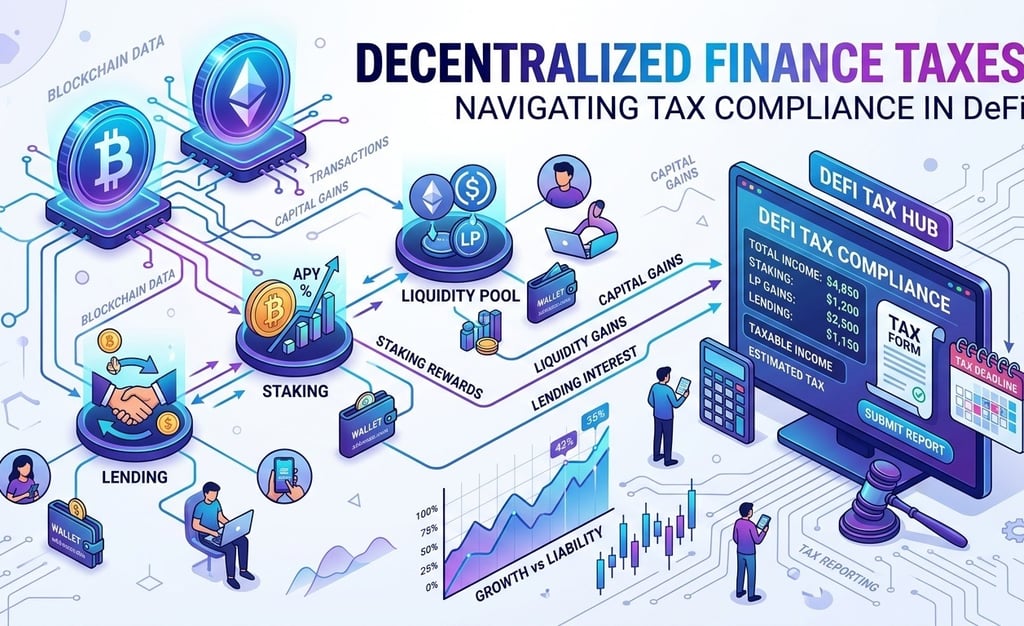
Lending and Borrowing: Users can lend out their crypto to earn interest, or borrow against their holdings by putting up other crypto as collateral.
Yield Farming: A more advanced strategy where users move their assets between different DeFi protocols to maximize their returns, often earning rewards in the form of new tokens.
Providing Liquidity: Investors deposit pairs of tokens into "liquidity pools," which are used by decentralized exchanges to facilitate trading. In return, they earn a share of the trading fees.
Trading on Decentralized Exchanges (DEXs): Platforms like Uniswap or PancakeSwap allow users to swap one token for another directly from their wallets, without a centralized intermediary.
While these platforms feel like a new world of finance, their underlying transactions often have familiar tax implications.
Why DeFi Taxation Gets So Complicated
The complexity of DeFi taxes stems from the very nature of these platforms. Transactions are often automated, frequent, and can involve multiple steps and tokens—all triggered by smart contracts.
A single yield farming strategy, for example, can generate a cascade of transactions:
Supplying tokens to a pool.
Receiving pool tokens in return.
Earning reward tokens distributed regularly.
Swapping those reward tokens for other assets.
Providing new liquidity with the swapped tokens.
This flurry of activity can generate hundreds or even thousands of taxable events in a single year. For the investor, this means that keeping accurate records isn't just a good idea—it's an absolute necessity for proper tax reporting.
Taxable DeFi Activities: A Closer Look
Let's break down some of the most common DeFi activities and examine their potential tax consequences.
Staking Rewards
Staking involves "locking up" your cryptocurrency to help secure a blockchain network, and in return, you receive rewards. The IRS has signaled that these rewards are generally treated as taxable income at the moment you receive them.
This means that when those staking rewards hit your wallet, you need to record their fair market value in U.S. dollars. That amount is reported as ordinary income. Later, when you eventually sell those reward tokens, any further increase (or decrease) in value will be subject to capital gains tax. This creates a two-layer tax event: income at receipt, and capital gains at sale.
Yield Farming Rewards
Yield farming often involves moving assets between protocols to capture the highest returns. The rewards you earn—often in the form of new governance tokens—are viewed similarly to staking rewards by most tax experts. They are likely to be treated as ordinary income at the time you receive them.
And just like with staking, if the value of those farmed tokens appreciates after you receive them, selling them later will trigger a separate capital gains event.
Liquidity Pool Rewards
When you provide liquidity to a pool on a DEX, you typically earn a portion of the trading fees. These fee rewards, often paid in the native tokens of the pool, are also generally considered taxable income. The exact treatment can depend on the specific mechanics of the pool, but the prudent approach is to assume that any reward you earn is a taxable event.
Token Swaps on Decentralized Exchanges
Swapping one token for another on a DEX, such as trading ETH for a new altcoin, is a clear-cut taxable event. The IRS treats this exactly like a trade on a centralized exchange: you are selling Token A and buying Token B. If Token A has increased in value since you acquired it, you have a capital gain to report, even though you never converted it to dollars.
What About DeFi Loans?
Borrowing cryptocurrency on a DeFi platform is generally not considered a taxable event. You are simply taking out a loan, not selling your assets.
However, other actions related to the loan can trigger taxes. For example:
Liquidation: If the value of your collateral drops too low and it gets liquidated by the protocol, that liquidation is treated as a sale of the collateral, which could result in a capital gain or loss.
Interest Payments: If you pay interest in a token that has appreciated in value, the act of transferring that token could be a taxable event.
Rewards: If the lending platform rewards you with tokens for borrowing, those rewards are likely taxable income.
The Critical Challenge: Tracking Your DeFi Activity
Attempting to track all of this activity manually—with transactions scattered across multiple wallets and protocols—is a recipe for missed transactions and inaccurate reporting. It's a task that quickly becomes impossible.
To stay compliant, you need to be diligent in keeping records of:
The date and time of every single transaction.
The type and amount of tokens involved.
The U.S. dollar value of every token at the exact time of each transaction.
Any gas fees paid (which can sometimes be deductible).
The wallet addresses involved.
Why Crypto Tax Software is Essential for DeFi
Given the sheer volume and complexity of DeFi transactions, specialized crypto tax software is no longer a luxury—it's a necessity. Tools like CoinTracker, Koinly, and others have evolved to handle the unique challenges of DeFi.
These platforms can often:
Connect directly to your wallets and pull transaction data from various blockchains.
Automatically track token swaps and liquidity pool interactions.
Calculate gains and losses for every taxable event.
Generate comprehensive tax reports that you can use to file your return.
Relying on software is the most practical way to ensure accuracy and save yourself from an overwhelming amount of manual work.
The Future of DeFi Tax Regulation
The regulatory landscape for DeFi is still evolving. As the sector continues to grow, the IRS and other government agencies are paying closer attention and working on developing clearer guidelines.
Future regulations are likely to include:
More specific guidance on the tax treatment of various DeFi activities.
Expanded reporting requirements for DeFi platforms and protocols, potentially classifying them as brokers.
For investors, this means that staying informed is more important than ever. What is a gray area today may become a clear rule tomorrow, and being aware of these changes is key to remaining compliant.
Conclusion
Decentralized Finance offers a thrilling new way to interact with digital assets, opening doors to financial strategies that were previously unavailable to the average person. But with these opportunities come complex tax responsibilities that cannot be ignored.
Many common DeFi activities—from earning staking rewards to swapping tokens on a DEX—can generate taxable income or capital gains. The key to navigating this complexity is a combination of education, meticulous record-keeping, and the strategic use of technology. By understanding how these transactions are taxed and using the right tools to track them, investors can confidently participate in the DeFi revolution while staying on the right side of IRS regulations.