
Do You Pay Taxes on Crypto Transfers? (Avoid Costly Mistakes)
Are crypto transfers taxable? Learn when crypto transfers are taxed, when they’re not, and how to avoid costly mistakes.
CRYPTO TAX GUIDE
💡 Introduction
Crypto taxes can get confusing fast.
One of the most common questions investors ask is:
👉 Do you pay taxes when transferring crypto?
The answer? It depends. And understanding the difference can help you avoid overpaying or making costly mistakes.
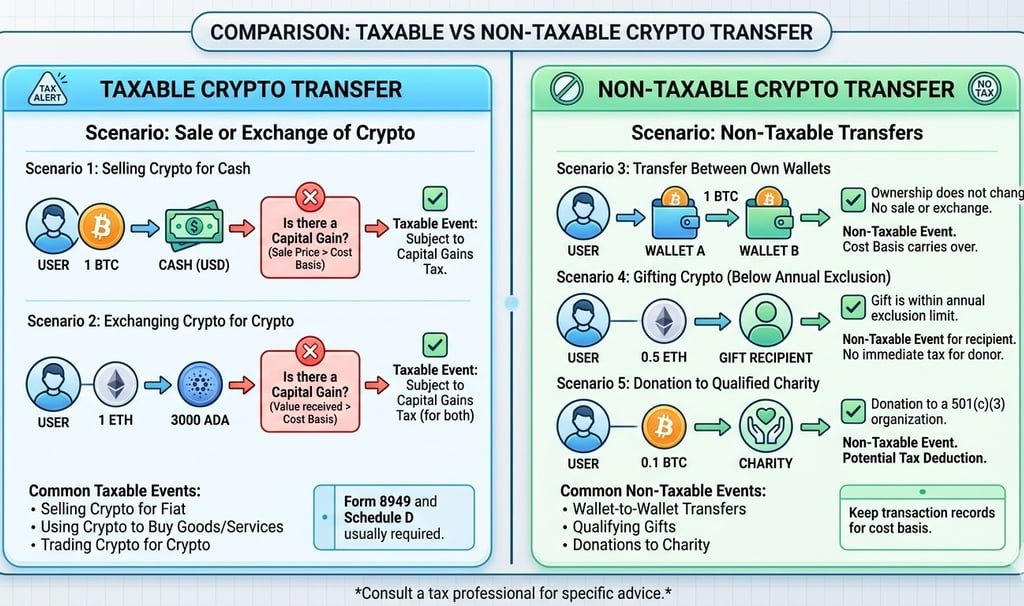
🔍 Are Crypto Transfers Taxable?
In most cases: NO.
According to the IRS:
Moving crypto between wallets you own is not a taxable event
You're not selling or generating income
✅ Example (Not Taxable)
Transferring Bitcoin between your own wallets
Moving funds from an exchange to your private wallet
👉 No taxes owed.
⚠️ When Crypto Transfers Become Taxable
This is where mistakes happen:
❌ Sending crypto to another person
➜ May be treated as a gift or payment
❌ Paying for goods or services
➜ Considered a taxable disposal
❌ Losing track of your cost basis
➜ Can lead to incorrect tax calculations
❌ Mislabeling a transfer
➜ It may be treated as a sale when it wasn't
🔐 Wallet-to-Wallet Transfers
If you're moving crypto between wallets you own:
👉 Not taxable — but you need to prove it.
To stay safe:
Keep clear wallet records
Document ownership
Use tools to tag transfers correctly
👉 Without proper tracking, a simple transfer can look like a sale.
🔄 Exchange Transfers (Common Issue)
Example:
Binance → Coinbase
If not tracked correctly, tax software may interpret this as:
A sale on Binance
A new purchase on Coinbase
⚠️ Result: fake gains and a higher tax bill.
🛠️ How to Track Transfers Properly
Manual tracking is error-prone.
Tools like Koinly, CoinTracker, and ZenLedger help you:
✔ Detect transfers automatically
✔ Match transactions across wallets
✔ Avoid double-counting gains
⚠️ Common Mistakes to Avoid
Steer clear of these:
Not labeling transfers between your own wallets
Using multiple wallets without a central record
Ignoring small transactions — they still affect your cost basis
Mixing personal transfers with payments to others
📊 Real Scenario Example
You buy ETH for $1,000
Transfer to another exchange
Sell later for $1,500
👉 Only the sale is taxable
✔ Taxable profit: $500
✔ Transfer between exchanges: not taxed
🧠 Pro Tip
Simple rule:
👉 If you didn't sell it or spend it, it's probably not taxable.
But if you:
Sell
Spend
Send to someone else
👉 Taxes may apply.
🧾 Conclusion
Transfers between wallets you own are usually not taxable — but poor tracking can make it look like they are.
To stay safe:
✔ Track everything
✔ Label correctly
✔ Use proper tools
👉 The biggest risk isn't taxes — it's incorrect data.
🚀 Final CTA
Don't risk overpaying due to tracking mistakes.
Start using Koinly to organize your transactions and stay compliant.
👉 Smart investors don't guess — they track.
🔗 https://koinly.io/?via=41639292&utm_source=affiliate