
How DeFi Yield Farming Is Taxed: A Complete Guide
Understanding the tax implications of earning rewards through decentralized finance liquidity pools.
DEFI & NFT TAXES
Introduction
Yield farming has emerged as one of the most popular—and potentially profitable—strategies in the decentralized finance ecosystem. By depositing cryptocurrency into liquidity pools and other DeFi protocols, investors can earn impressive returns in the form of additional tokens.
But before you get too excited about those growing rewards, there's an important question to address: how is all this income taxed?
The answer, like much of DeFi, involves some complexity. Yield farming rewards typically create tax obligations at multiple points, and understanding these rules is essential for staying compliant. This guide breaks down exactly how the IRS views yield farming rewards and what you need to track to report them accurately.
What Is Yield Farming?
First, let's establish what we're talking about. Yield farming (also known as liquidity mining) is the practice of lending or staking cryptocurrency in DeFi protocols to earn rewards. These rewards are typically paid in the protocol's native governance tokens or a share of trading fees .
Common yield farming activities include:
Providing liquidity to decentralized exchanges by depositing pairs of tokens into pools
Lending assets through DeFi lending platforms
Staking LP tokens (liquidity provider tokens) to earn additional rewards
The appeal is clear: yields can be significantly higher than traditional savings accounts or even standard crypto staking. But with those higher potential returns comes a more complex tax picture.
The Basic Rule: Rewards Are Taxable Income
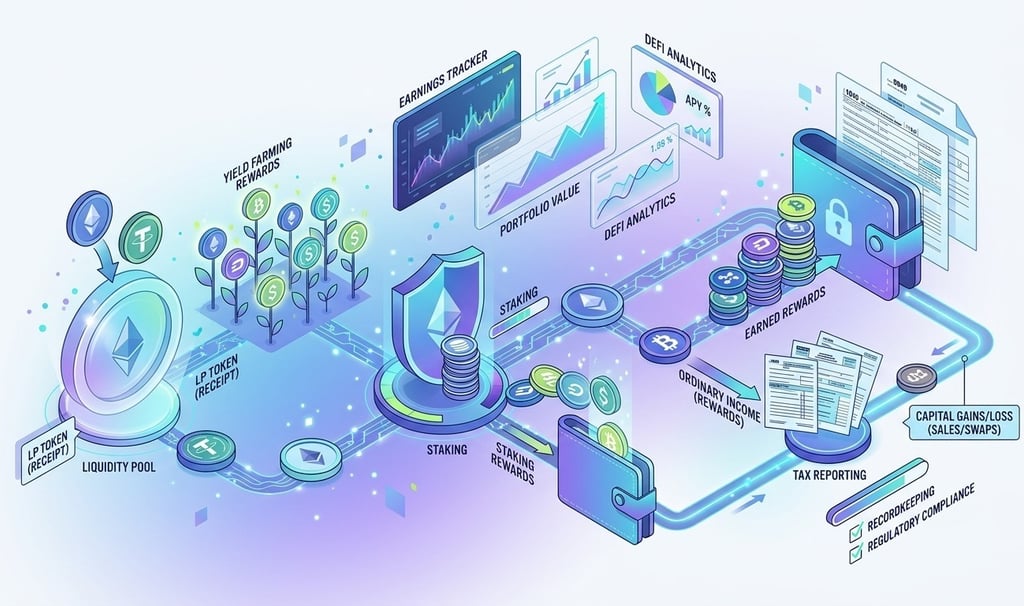
The fundamental principle of yield farming taxation is this: rewards are generally treated as taxable income at the time you receive them .
When you earn yield farming rewards, the IRS views this as ordinary income, similar to earning interest from a bank or receiving payment for services. The fair market value of the tokens at the moment they hit your wallet becomes your taxable income for that year.
Example: You provide liquidity to a DeFi protocol and earn 50 governance tokens when each token is worth $10. You have received $500 of taxable income, regardless of whether you sold the tokens or not.
This income is typically reported on Schedule 1 of your tax return as "Other Income" .
The Second Layer: Capital Gains on Appreciated Rewards
But the tax story doesn't end with the initial receipt of rewards. Once you hold those reward tokens, they become assets in your portfolio with their own cost basis (the value at which you received them).
If the value of those tokens increases and you later sell or trade them, you'll have a second tax event: a capital gain (or loss) on the disposition .
Example (continued): You received those 50 governance tokens when they were worth $10 each, for a total value of $500. Six months later, the tokens have risen to $15 each, and you sell them all for $750.
First tax event (income): You already reported $500 of ordinary income when you received the tokens.
Second tax event (capital gain): You now have a capital gain of $250 ($750 sale price - $500 cost basis).
If you held the tokens for less than a year before selling, this is a short-term capital gain, taxed at your ordinary income rate. If you held them for more than a year, it qualifies for the lower long-term capital gains rates.
The Complexity of DeFi Transactions
What makes yield farming particularly challenging for tax purposes is the sheer number of transactions involved. A single yield farming strategy can generate:
Multiple reward distributions (sometimes daily or even continuously)
Token swaps when moving in and out of pools
LP token creation and redemption (which may themselves be taxable events)
Compounding transactions where rewards are automatically reinvested
Each of these transactions may have tax implications, and tracking them manually is nearly impossible for active farmers.
Impermanent Loss and Taxes
One unique aspect of providing liquidity to automated market maker (AMM) pools is the risk of impermanent loss—a temporary loss in value compared to simply holding the assets. While impermanent loss isn't directly a tax concept, it becomes relevant when you exit a position.
When you withdraw your liquidity, you're typically receiving a different ratio of tokens than you deposited. This withdrawal is treated as a sale of your LP tokens and a purchase of the underlying assets, potentially triggering capital gains or losses based on the change in value .
Special Considerations for DeFi Protocols
Auto-Compounding Protocols
Some DeFi protocols automatically reinvest your rewards to compound your returns. Even though you never "receive" the tokens in your wallet, tax experts generally believe these automatic reinvestments still create taxable events. The IRS has not provided specific guidance on auto-compounding, but the conservative approach is to treat each reinvestment as income followed by a reinvestment .
Losses in DeFi
Not all DeFi adventures end profitably. If you lose money on a yield farming strategy—whether through market movements, impermanent loss, or even a protocol hack—you may be able to claim a capital loss. These losses can offset other capital gains and reduce your overall tax liability .
Record-Keeping Essentials for Yield Farmers
Given the complexity, meticulous record-keeping isn't optional for serious yield farmers. You need to track:
Date and time of every reward distribution
Fair market value of rewards in USD at the moment of receipt
Transaction hashes for verification
Gas fees paid (which may be deductible or added to cost basis)
All token swaps and liquidity pool entries/exits
How Crypto Tax Software Can Help
For anyone actively yield farming, manual tracking is practically impossible. This is where specialized crypto tax software becomes essential. Platforms like CoinTracker, Koinly, and ZenLedger have evolved to handle DeFi complexity by:
Connecting directly to wallet addresses and scanning blockchain data
Identifying reward distributions and their value at receipt
Tracking cost basis across multiple DeFi interactions
Generating comprehensive tax reports that account for both income and capital gains
These tools can transform what would be months of manual spreadsheet work into a manageable process.
A Note on Regulatory Uncertainty
It's important to acknowledge that the IRS has not issued definitive guidance specifically for many DeFi activities. The tax treatment described here represents the consensus among tax professionals based on existing principles—that rewards are income when received, and subsequent transactions create capital gains or losses.
As DeFi continues to grow, more specific regulations are likely. The OECD's Crypto-Asset Reporting Framework (CARF) and potential future IRS guidance may provide clearer rules for DeFi taxation .
Conclusion
Yield farming offers compelling opportunities for crypto investors to earn returns on their assets, but those returns come with tax responsibilities that shouldn't be overlooked.
The basic framework is straightforward: rewards are taxable income when received, and any subsequent appreciation creates capital gains when sold. The challenge lies in the volume and complexity of transactions that active yield farming generates.
By understanding these principles, keeping detailed records, and leveraging specialized tax software, investors can participate in DeFi yield farming confidently—maximizing their returns while staying compliant with tax obligations.