
Latest Crypto Tax News in the United States: What Investors Need to Know in 2026
A new era of reporting is here—from Form 1099-DA to global data sharing.
CRYPTO TAX NEWS
Introduction
The cryptocurrency market evolves at a breakneck pace, and tax regulations are working hard to catch up. For investors in the United States, 2026 marks a significant turning point. After years of self-reporting with limited third-party oversight, the IRS is rolling out a suite of new rules and reporting requirements that will fundamentally change how crypto taxes are filed and enforced.
Staying informed about these changes isn't just a good practice—it's essential for avoiding penalties and staying compliant. This article breaks down the most important developments in U.S. crypto taxation for 2026 and what they mean for you.
A Quick Look Back: The Road to 2026
For years, the IRS has treated cryptocurrency as property, requiring investors to track and report their own gains and losses . In 2019, the agency added a direct crypto question to Form 1040 and began ramping up enforcement efforts. But the real game-changer arrived with the Infrastructure Investment and Jobs Act of 2021, which mandated expanded information reporting for digital assets . After years of implementation delays, those rules are finally taking effect now.
The Big Story: Form 1099-DA Arrives
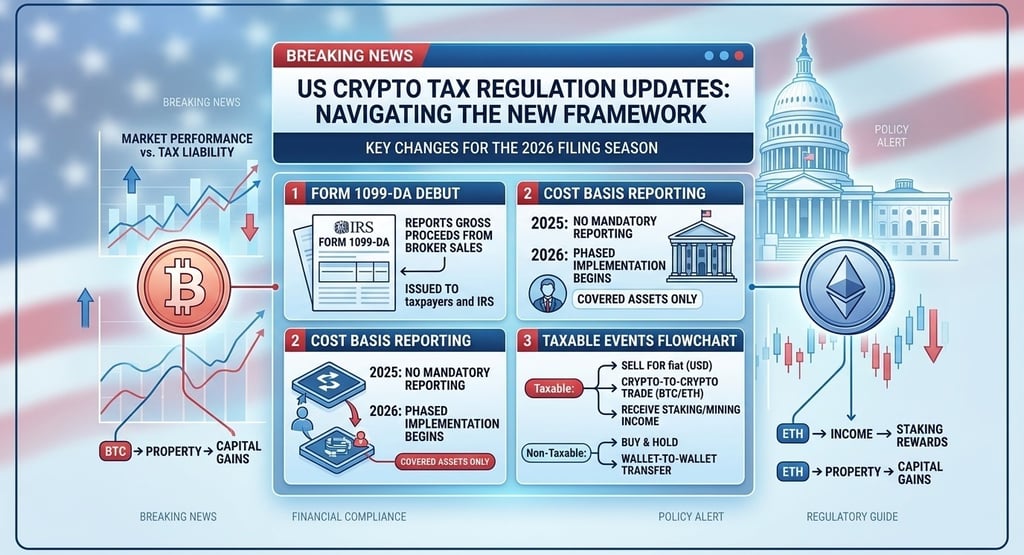
The most significant change for the 2026 filing season is the debut of Form 1099-DA (Digital Asset Proceeds From Broker Transactions) . Starting with transactions from the 2025 tax year, crypto brokers—including centralized exchanges like Coinbase and even some decentralized platforms—must issue this new form to their users and the IRS .
What Form 1099-DA Reports (For Now)
For the 2025 tax year (filed in 2026), Form 1099-DA primarily reports gross proceeds from digital asset sales . Think of it as a flag to the IRS that says, "This taxpayer engaged in crypto transactions." Critically, cost basis information is not yet required on these forms . This means the IRS will see that you sold crypto and for how much, but they won't automatically know what you originally paid. That calculation still falls squarely on your shoulders.
Investor reaction to the new form has been mixed. A survey by Awaken Tax found that most crypto investors are concerned about the shift from self-reporting to automatic transaction reporting . Andrew Duka, the company's founder, described the new rules as a "blunt instrument" crafted by lawmakers unfamiliar with crypto's complexities, noting that real users move funds between multiple wallets and interact with DeFi protocols using complex strategies .
What's Coming in 2027 (For 2026 Transactions)
Starting with the 2026 tax year (filed in 2027), the reporting requirements will expand significantly. For "covered securities"—generally, digital assets acquired on or after January 1, 2026, and held continuously in the same broker's account—brokers will be required to report cost basis information as well . This will bring crypto reporting much closer to how stocks are reported today.
However, experts warn that the transition will be messy. Deloitte's Seth Wilks estimates that in the first year of basis reporting, perhaps only 5% of a customer's transactions might qualify as covered . Assets acquired before 2026 or transferred from outside wallets will remain "noncovered securities," meaning brokers won't report their basis . This patchwork system is expected to cause significant confusion .
A Fundamental Shift: Per-Wallet Cost Basis Tracking
Another major change that took effect on January 1, 2025, is the end of the "universal method" for tracking cost basis . The IRS now requires investors to track and report cost basis separately for each wallet or exchange account .
Previously, some investors lumped together all holdings of a single token across multiple platforms. That's no longer allowed. If you bought Bitcoin on both Coinbase and Kraken, you must track the cost basis for each exchange's holdings separately. When you sell, you can only match the sale to assets within that specific wallet or account .
This change has significant implications for active traders and DeFi users, who often move assets across multiple platforms. Reconstructing historical cost basis for each wallet is now a massive—but necessary—undertaking . The IRS did provide a safe harbor in Revenue Procedure 2024-28 to help taxpayers allocate their existing basis to specific wallets as of January 1, 2025, but the compliance window is tight .
The Global Picture: International Cooperation Heats Up
Crypto taxation is no longer just a national issue. The United States is part of a growing global movement to increase transparency. The Organisation for Economic Co-operation and Development (OECD) developed the Cryptoasset Reporting Framework (CARF) , which nearly 50 countries—including the UK and many others—began enforcing in 2026 .
Under CARF, crypto exchanges must collect users' tax residency details and report transaction data to local tax authorities. That data will then be shared internationally between participating countries starting in 2027 . The goal is to close loopholes on undeclared crypto gains and significantly reduce anonymity. For U.S. investors with overseas accounts, this means the era of hiding crypto income offshore is effectively over.
The Regulatory Debate: What's Still Being Discussed
Even as these rules roll out, policymakers continue to debate the future of crypto taxation. The Blockchain Association, a major industry lobbying group, has submitted a tax reform proposal to Congress that includes several key provisions :
Treating stablecoins as cash for everyday payments to reduce tax complexity.
Establishing a de minimis exemption for small crypto transactions (e.g., under a certain dollar amount), arguing that reporting every tiny gain creates administrative burdens for taxpayers and the IRS.
Applying the wash sale rules to digital assets, allowing investors to claim losses even if they repurchase the same asset.
Taxing mining and staking rewards as capital gains rather than ordinary income.
However, these proposals face opposition. Senator Elizabeth Warren has strongly criticized the idea of a small-transaction exemption, arguing it could reduce federal revenue by approximately $58 billion . For now, none of these proposed changes have been enacted, and existing rules remain in place .
What This Means for Investors: Practical Takeaways
With all these changes, what should the average crypto investor do?
Don't Rely Solely on Form 1099-DA. For the 2025 tax year, these forms won't include your cost basis. You are still responsible for calculating your own gains and losses accurately . If you simply report the gross proceeds without subtracting your basis, you could massively overpay (or underpay) your taxes.
Get Your Records Organized Now. The new per-wallet cost basis rules make record-keeping more critical than ever. If you haven't already, start compiling transaction histories for every exchange and wallet you've used. Crypto tax software is no longer a luxury—it's a necessity .
Answer the Crypto Question Truthfully. The question on Form 1040 about digital asset transactions is still there and must be answered by everyone . Failing to answer accurately can lead to penalties.
Prepare for Potential Delays and Errors. Experts warn that some brokers may struggle to issue Forms 1099-DA correctly and on time during this transitional period . The IRS has provided "good faith" penalty relief for brokers, but that doesn't relieve your responsibility to file accurately. If your form is delayed, your own transaction records should allow you to file on time .
Consider Professional Help. With the rules becoming exponentially more complex, consulting a tax professional who specializes in cryptocurrency is a wise investment, especially if you're active in DeFi or trade frequently.
Conclusion
The landscape of cryptocurrency taxation in the United States has changed dramatically. With the introduction of Form 1099-DA, the shift to per-wallet cost basis tracking, and increasing global cooperation, the era of under-the-radar crypto investing is over.
These changes bring both challenges and clarity. While the transition may be bumpy, the move toward standardized reporting also signals that cryptocurrencies are here to stay as a legitimate asset class . For investors, the path forward is clear: stay informed, keep meticulous records, and embrace the tools and professional advice needed to navigate this new regulatory environment. Compliance is no longer optional—it's the price of admission to the digital asset economy.